




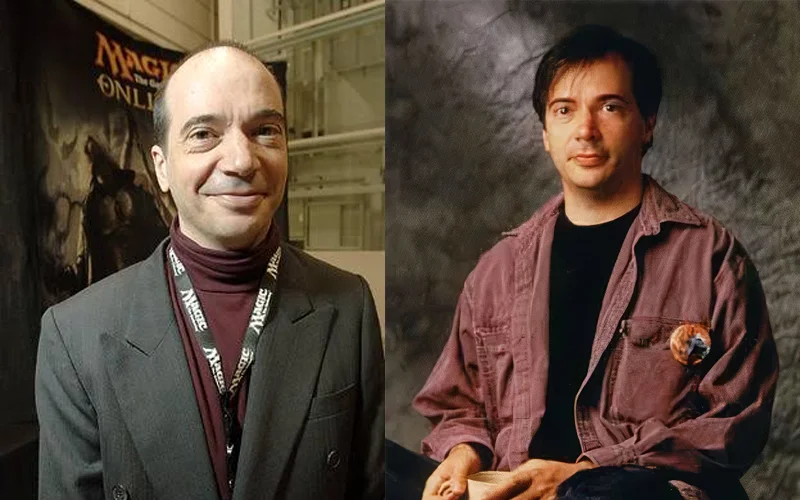
Who Is Richard Garfield?
Richard Garfield is an American game designer, mathematician, and professor whose work changed the modern tabletop gaming industry. He was born on June 26, 1963, in Philadelphia, Pennsylvania, and became internationally known after creating Magic: The Gathering in 1993. His combination of mathematics, creativity, and game design helped establish the collectible card game as a major form of entertainment.
Although Magic: The Gathering remains his most famous creation, his career has never been limited to one franchise. Richard Garfield has designed card games, board games, and digital games, including RoboRally, Netrunner, Vampire: The Eternal Struggle, King of Tokyo, Bunny Kingdom, and KeyForge.
His academic background is equally notable. He earned a Ph.D. He earned his degree in combinatorial mathematics from the University of Pennsylvania in 1993. That mathematical training became an important part of his approach to game design, particularly when developing systems involving probability, resource management, and complex interactions.
Quick Bio
| Fact | Details |
| Full Name | Richard Garfield |
| Born | June 26, 1963 |
| Birthplace | Philadelphia, Pennsylvania, United States |
| Profession | Game Designer, Mathematician, and Professor |
| Academic Degree | Ph.D. in Combinatorial Mathematics |
| University | University of Pennsylvania |
| Famous Creation | Magic: The Gathering |
| Magic Debut | 1993 |
| First Wife | Lily Wu |
| Second Wife | Koni Kim |
| Family Connection | Great-great-grandson of President James A. Garfield |
Early Life and Education
Richard Garfield developed an early interest in mathematics and games, interests that eventually shaped both his academic path and professional career. He studied mathematics at the University of Pennsylvania and earned his Ph.D. in combinatorial mathematics in 1993, the same year Magic: The Gathering was released.
Before making game design his primary career, Garfield also worked as a mathematics professor at Whitman College in Washington. His academic training gave him a strong foundation in probability, structure, and complex systems, ideas that later became important to his approach to game design.
He also brought his academic perspective to writing. Garfield co-authored Characteristics of Games, a book that examines game structure, player behavior, luck, skill, and competition from a systematic perspective.
The Creation of Magic: The Gathering
The story of Richard Garfield MTG began with a game that was not Magic at all. Garfield originally approached Wizards of the Coast founder Peter Adkison with RoboRally. At the time, Wizards of the Coast felt the original concept would be too costly to manufacture. Instead, Peter Adkison encouraged Garfield to create a more compact and affordable game that could easily be taken to and played at gaming conventions.
That request eventually produced Magic: The Gathering.
Garfield experimented with a concept called Five Magics and developed the idea that players did not necessarily need to own identical collections of game pieces. Instead, they could acquire individual cards and build their own decks.
The idea became revolutionary. Magic: The Gathering was released at Gen Con in 1993 and introduced a combination of collectible cards, deck construction, randomized booster packs, strategic resource management, and competitive play that had not previously existed in this form.
The success of the game transformed Wizards of the Coast and created the foundation for the modern trading card game industry.
His Role in Magic’s Early Years
Richard Garfield was responsible for many of the fundamental concepts that made Magic distinctive. The five-color mana system gave different colors their own identities while restricting how players could combine cards. Randomized card distribution also added a collecting element alongside the game’s strategic side.
After working at Wizards of the Coast, Garfield moved toward independent game design and consulting rather than remaining involved in the game’s day-to-day development. He later returned to contribute to several Magic projects, including Ravnica: City of Guilds and Dominaria.
Garfield left Wizards of the Coast as a full-time employee around 2000, but his connection with Magic: The Gathering continued through later design contributions. This allowed him to explore new games while occasionally bringing his experience back to the franchise he originally created.
Games Beyond Magic
The success of Magic: The Gathering could easily have defined Richard Garfield’s entire career, but he continued creating games in very different formats.
One of his earliest major projects was RoboRally, the board game he had originally tried to publish before Magic. It challenges players to program robot movements while dealing with hazards on a factory board.
He later designed Netrunner, a card game built around asymmetric gameplay. One player controls a corporation while the other takes the role of a hacker, giving the two sides different objectives and tools.
Another important title was Vampire: The Eternal Struggle, originally released as Jyhad. Unlike many competitive card games, it placed a strong emphasis on multiplayer politics, negotiation, and temporary alliances.
His board-game portfolio later expanded with King of Tokyo, a fast-paced dice game in which giant monsters compete for control of the city. Bunny Kingdom introduced drafting and territory-building mechanics, while The Hunger combined deck building with a race against time.
Garfield later developed KeyForge, a card game built around a distinctive deck system. Rather than having players assemble their own decks card by card, each deck comes preconstructed with its own unique combination of cards.
How Mathematics Shaped MTG
Garfield’s academic credentials eventually became part of Magic itself through the Richard Garfield, Ph.D. card.
The card appeared in Unhinged, a humorous silver-bordered expansion designed around unusual and deliberately disruptive mechanics. Its ability allows cards to be played as though they were other cards with the same mana cost, creating the style of play commonly associated with Mental Magic.
The joke works because Garfield’s real-world doctorate is transformed into a game mechanic. Instead of merely putting his name on a card, Wizards of the Coast created a rule that demands extensive knowledge of the game’s card pool.
That makes Richard Garfield, Ph.D. one of the most recognizable tributes to the creator inside his own game.
The Proposal That Became Magic History
Some of the most unusual stories surrounding Richard Garfield involve cards that were created for his personal life rather than commercial sets. The special card known as Proposal was created in 1993 for his then-girlfriend Lily Wu. Garfield used it during a game as a way of proposing marriage.
The story became famous among Magic collectors because the card was never a normal commercial release. Only a very small number of copies were produced, making it an exceptionally rare piece of Magic: The Gathering history.
The card’s concept was also unusually personal. Its game effect incorporated the marriage proposal into the rules, turning a real-life question into an in-game victory condition.
His First Marriage to Lily Wu
Richard Garfield’s first wife was Lily Wu. Their relationship predates Garfield’s rise to international fame through Magic: The Gathering.
The couple’s marriage became particularly memorable within the gaming community because of the Proposal card and other cards connected to their family.
One famous example is Wyluli Wolf from Arabian Nights. The name is widely recognized as an anagram of Lily Wu, making it one of the subtle personal references associated with early Magic.
Garfield and Lily Wu later divorced. Their family history also became connected to special commemorative cards, including Splendid Genesis and Fraternal Exaltation, which were created around important family milestones.
Marriage to Koni Kim
Richard Garfield later married Koni Kim in 2015. Their wedding was also commemorated through Magic-related artwork.
A special card called Phoenix Heart was created for the occasion, continuing Garfield’s unusual tradition of connecting important moments in his personal life with game design.
Unlike a standard commercial release, these personal cards were created as commemorative pieces. Their rarity and unusual origins have made them especially interesting to collectors and longtime fans of Magic.
The Garfield Family Connection
One of the more unusual facts in his biography is his connection to former U.S. President James A. Garfield.
Richard Garfield is the great-great-grandson of James A. Garfield, who served as the 20th president of the United States in 1881.
The connection has occasionally attracted attention because both men had strong interests in intellectual subjects. However, Richard’s career developed in mathematics and game design rather than politics.
The family relationship is therefore a genealogical connection rather than a professional one.
Richard Garfield Net Worth
Richard Garfield’s net worth is estimated at $10 million to $125 million, although no exact figure has been publicly confirmed. His wealth is largely associated with the success of Magic: The Gathering and his involvement with Wizards of the Coast.
A major financial milestone came in 1999, when Hasbro acquired Wizards of the Coast for $450 million in cash. His reported ownership in the company meant that the Wizards of the Coast deal could have had a major impact on his personal wealth.
Beyond the acquisition, Garfield has continued to earn through game royalties, licensing agreements, consulting work, and his extensive catalog of card and board games. His long-running involvement with Magic: The Gathering and other successful titles provides additional income through intellectual property and publishing arrangements.
Is Richard Garfield Still Alive?
Yes, Richard Garfield is alive and continues to work in game design.
His career has remained active long after the original release of Magic: The Gathering. Rather than concentrating exclusively on the franchise that made him famous, he has continued exploring different formats and new game systems.

His more recent projects demonstrate an interest in both digital and tabletop games. He has worked on projects that combine strategic decision-making with systems designed to avoid overly predictable or solved gameplay environments.
His continuing activity shows that he remains interested in developing new ideas rather than relying solely on the success of his earlier work.
His Influence on Modern Game Design
Richard Garfield’s influence extends far beyond the players who know his name through Magic: The Gathering. The collectible card game model he helped establish became one of the most important developments in modern tabletop entertainment.
His later work demonstrates that he is interested in experimentation rather than simply reproducing the formula that made him famous. As a designer, he has repeatedly explored asymmetry, procedural generation, deck building, political interaction, probability, drafting, and resource management.
His mathematical background gives his work a distinctive foundation, but his success comes from combining formal systems with human decision-making. Players still need to make choices, take risks, respond to opponents, and adapt to changing circumstances.
Conclusion
Richard Garfield’s career shows how a strong academic background and creative thinking can reshape an entire industry. From creating Magic: The Gathering to designing games such as RoboRally, Netrunner, King of Tokyo, and KeyForge, he has consistently explored new ways to make games strategic, interactive, and engaging.
His work as a mathematician and designer has influenced generations of players and creators. Even after the success of Magic: The Gathering, he continued experimenting with new ideas and formats, demonstrating that his interest in game design goes far beyond a single title. Today, Richard Garfield remains one of the most influential and versatile figures in modern game design.
Frequently Asked Questions
1. Who is Richard Garfield?
He is an American game designer, mathematician, and professor best known for creating Magic: The Gathering. His work helped shape the modern collectible card game industry and influenced how strategic tabletop games are designed.
2. What made Richard Garfield important in gaming?
He introduced a new way of thinking about cards, randomness, and player choice through customizable decks. That design approach turned one successful game into a whole category of games that followed.
3. What is Richard Garfield known for beyond Magic: The Gathering?
He has designed several well-known games, including RoboRally, Netrunner, Vampire: The Eternal Struggle, King of Tokyo, and KeyForge. These titles show his range across board games, card games, and digital play.
4. How did Richard Garfield’s math background shape his work?
His training in combinatorial mathematics helped him build games with balance, probability, and layered strategy. It gave his designs a strong structural logic that still stands out in tabletop gaming.
5. What is Richard Garfield’s most famous game?
His most famous game is Magic: The Gathering, released in 1993. It became the first modern collectible card game and remains one of the most influential games ever made.
6. What other games did he design?
He worked on a wide mix of games across different styles and formats. His catalog includes fast board games, asymmetric card games, and experimental systems that reward smart decision-making.
7. Is he still active in game design?
Yes, he continues to work on new projects and occasional collaborations. His later work shows that he still enjoys testing fresh mechanics and different game structures.
8. What is Richard Garfield’s connection to the Proposal card?
A special card called Proposal became part of his personal life story and is closely linked with his first marriage. It is one of the most talked-about custom cards in Magic history.
9. Is he related to President James A. Garfield?
Yes, he is the great-great-grandson of former U.S. President James A. Garfield. The family connection is real, but his own reputation comes from mathematics and game design.
10. Why does his work still matter today?
His ideas changed how people collect, build, and play strategy games. Even decades later, designers still study his methods because they combined creativity, competition, and system design in a lasting way.