


Dust doesn’t just sit on your rooftop — it quietly eats into your electricity bill. Regular solar panel cleaning can restore anywhere from 20% to 60% of the power lost to dust, bird droppings, and pollution film.
In dusty regions like Pakistan, panels are exposed to sand, smog, and seasonal grime almost year-round. A gentle wash every three to six months isn’t optional maintenance — it’s what keeps a system running close to its rated capacity.
Solar Panel Cleaning: Quick Facts
| Fact | Detail |
| Energy recovery from cleaning | Up to 20% – 60% |
| Recommended cleaning frequency | Every 3 – 6 months in dusty areas |
| Best time to clean | Early morning (before 7 a.m.) or evening |
| Average DIY cleaning time | 20 – 30 minutes |
| Water to use | Clean, low-pressure; demineralized preferred |
| Core tools needed | Telescopic pole, soft brush, squeegee |
| Never use | Pressure washers, harsh chemicals, metal tools |
| Energy recovery with robots | Up to 30% |
Cleaning Solar Panels Without Damage
Solar glass punishes shortcuts. Getting how to clean solar panel surfaces right without damaging them comes down to three things — safety, timing, and technique — and skipping any one of them tends to show up as a scratch, a crack, or a wasted afternoon.
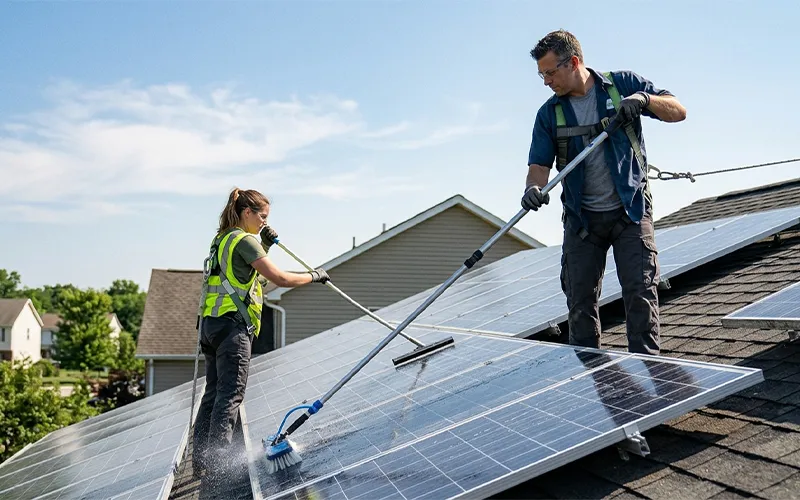
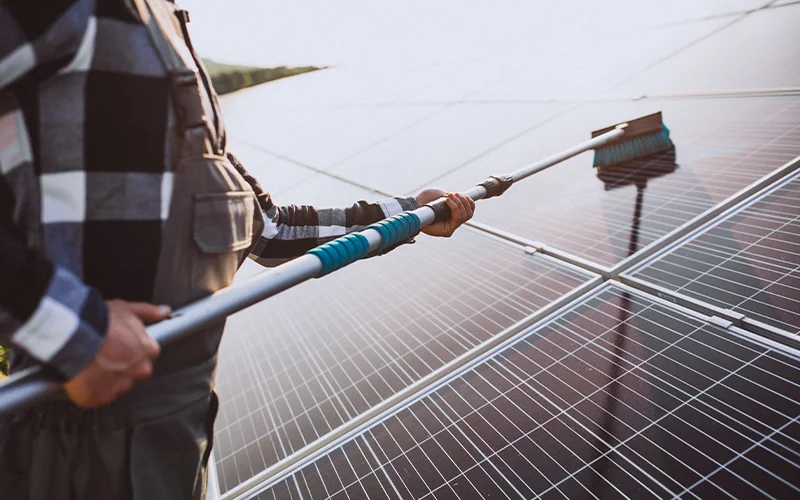
Before you touch a single panel, switch off the system. Locate the AC and DC isolators on your solar inverter and flip both to off — this removes any risk of electrical shock while you’re working with water nearby. Once the system is de-energized, stay off the roof itself and use a telescoping pole to reach and scrub panels safely from the ground.
Timing matters just as much as safety. Solar glass heats up fast under direct sun, and spraying cold water onto hot panels can trigger thermal shock strong enough to crack the surface. Stick to early morning hours, ideally before 7 a.m., or wait until evening; an overcast day works fine too.
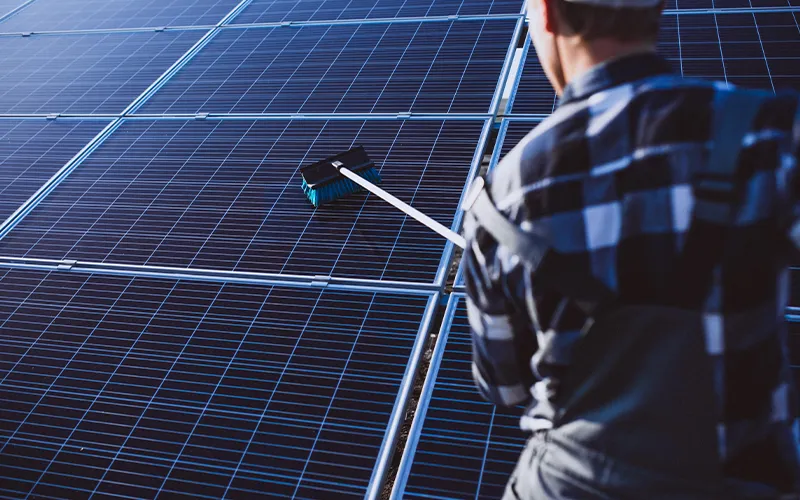
Once you’re set up, start with the loose stuff. Brush away leaves, twigs, and dry dust with a soft-bristle brush before any water touches the panel, then rinse from top to bottom with a low-pressure hose. Go over stubborn spots like bird droppings with a soft brush or microfiber pad.
Finish by squeegeeing the surface dry right away. Skipping this step lets hard water evaporate and leave behind chalky mineral spots that block sunlight almost as effectively as the dirt you just removed — this is the core routine behind effective solar panel cleaning, and it barely changes whether you’re doing it yourself or hiring someone.
Cleaning Solar Panels at Home
None of this requires commercial-grade equipment. The whole point of how to clean solar panel at home setups is that it takes about 20 to 30 minutes with tools most people already own — a telescoping pole fitted with a soft nylon brush or microfiber head, a garden hose with a gentle spray nozzle, and a window squeegee.
If your panels have picked up an oily film from nearby traffic or cooking exhaust, mix a bucket of clean water with a few drops of mild dish soap. Otherwise, plain water is enough, and using demineralized or purified water where possible cuts down on the streaking that hard tap water tends to leave behind.
The same safety and timing rules from above still apply at home — there’s no shortcut version for a residential rooftop. Sticking to this routine every few months is what stops the kind of caked-on buildup that eventually needs harsher scrubbing, which is exactly what you want to avoid on tempered glass.
Mistakes That Damage Your Panels
A few habits can undo months of good maintenance in seconds. Pressure washers are the biggest offender — the force is strong enough to break the rubber seals around the panel frame and push water into the internal wiring. Harsh chemicals cause quieter damage, since bleach, laundry detergent, and other abrasive soaps strip away the anti-reflective coating on the glass and leave panels more prone to dust buildup over time.
Metal tools are just as risky. Wire brushes and scrapers scratch the glass surface, and those scratches create tiny shadows across the solar cells that reduce power output permanently. And no matter how tempting it is to walk across the array to reach a far corner, stepping on panels can cause micro-cracks that are invisible to the eye but damaging enough to shorten a panel’s lifespan.
Best Tools for Solar Panel Cleaning
A stiff household broom will scratch solar glass long before it cleans it, which is exactly why proper solar panel cleaning tools exist. A water-fed telescopic pole is the centerpiece of most home setups, extending anywhere from 8 to 20 feet with a built-in water channel and an on/off valve on the handle, so flow can be controlled without walking back to the tap.
Pair the pole with a soft, split-tip nylon brush head, sometimes called a “flagged” bristle design. It lifts caked-on dirt and dried grime without scratching the glass the way a stiff household broom would. Dual-action squeegees combine a microfiber scrubbing pad on one side with a rubber squeegee blade on the other, letting you wash and dry in a single pass.
Small anti-dust drainage clips are worth adding too. They snap onto the lower edge of the panel frame and use capillary action to drain away the muddy puddles that collect after rain, preventing the localized hot-spot damage standing water can cause. For panels coated in oily soot or industrial residue, a pH-neutral solar shampoo such as Solar Wash Protect dissolves the film without leaving a sticky chemical residue behind.
Which combination makes sense depends on the setup:
| Tool Type | Best Suited For | Key Feature to Check |
| Water-Fed Telescopic Rod | 1–2 story rooftops | On/off water valve |
| Microfiber Duster Pole | Daily dry cleaning | Bendable, washable head |
| Full High-Pressure Kit | Large commercial arrays | Soft brush & long pole |
Choosing a Solar Panel Cleaning Kit
Not everyone wants to shop for a pole, brush, and squeegee separately. A ready-made solar panel cleaning kit bundles everything into one purchase, and PVcare’s premium version includes Nylon 66 bristle brush heads, adjustable Titanflex aluminum poles, and interchangeable 75° and 90° elbow connectors for reaching awkward rooftop angles.
On the more affordable end, AlClean and similar sellers on Daraz offer a 12-foot aluminum rod with a built-in water inlet and manual valve. There’s also a water-conscious option from AgroPower featuring a 12-foot flexible pole with split-tip bristles that uses just half a liter of water per panel, useful where water access is limited.
Budget shoppers on Daraz have several entry-level choices too. A 20-foot stainless steel water-flow kit usually comes with a free squeegee and a small shampoo sample. A basic 9-foot sponge-and-squeegee pole suits ground-mounted or low patio installations, while dry microfiber duster kits work for quick dust sweeps without any water at all.
Whichever kit you pick, check three things before buying: the pole should be aluminum or fiberglass rather than iron, which rusts quickly once exposed to water; the brush head should be labeled nylon or soft microfiber; and the squeegee blade should be dense rubber, since a flimsy blade won’t clear standing water fast enough to keep it from drying into a chalky film.
Solar Panel Cleaning Robots
Rooftop access isn’t always necessary anymore. A solar panel cleaning robot automates the entire process and can recover up to 30% of the energy lost to dust and grime — a meaningful gain for larger installations, or for anyone who’d rather skip the roof altogether in regions hit hard by sandstorms or industrial pollution.
These machines generally fall into three categories. Handheld remote-controlled crawlers, such as the SolarCleano F1, are tracked units that sit directly on the array while an operator steers them from the ground with a joystick. Fixed, frame-mounted automated bars are permanently installed motorized wipers that slide across a row of panels on a timer or via IoT sensors, and waterless dry-cleaning robots use microfiber rollers and air blowers instead of water, making them a practical choice in arid areas where water is scarce.
Beyond convenience, robots solve two problems manual cleaning can’t fully avoid. Their lightweight tracks distribute weight evenly across the glass, eliminating the uneven footstep pressure that causes micro-cracks, and their sensors reach tight corners and frame edges that a telescoping pole often misses.
In Pakistan, PVcare imports commercial-grade robots with fall-prevention sensors and anti-friction tracking for industrial solar farms. Neexgent Solar supplies heavy-duty attachments built for large commercial arrays, and Multan Electronics offers a more compact IoT-based system that sprays a fine water mist and can be controlled through a mobile app.
Equipment and Professional Help
PVcare Pakistan remains the most complete option for sourcing solar panel cleaning equipment locally, stocking everything from entry-level water-fed poles to motorized crawler robots for commercial rooftops. For anyone maintaining an existing setup rather than buying a full kit, engineering hubs in Lahore, Karachi, and Islamabad stock individual replacement parts like drainage clips and brush heads.
Not every rooftop is safe to climb, though, and steep or high installations are better left to trained technicians. In Karachi, well-reviewed options include Wipe and Wash Solar Panel Cleaning Service in North Nazimabad, Solar Panels Cleaning Solutions in Shah Latif Town, and Solar Panel Cleaning Karachi in Baldia. Homeowners in Hyderabad can turn to local engineering firms such as Electsun Engineering Co. or KK Solar in Latifabad for routine maintenance.
Final Thoughts
Whether it’s handled with a basic pole and squeegee or a full kit and robot, the underlying goal of solar panel cleaning stays the same — keep the glass clear so sunlight reaches the cells unobstructed. Match the schedule to your environment, respect the timing and pressure rules along the way, and the payoff shows up directly on the electricity bill.
Frequently Asked Questions
How often should solar panels be cleaned?
In dusty regions, panels typically need washing every three to six months. Watching for visible dust buildup or a drop in output is a more reliable signal than sticking to a fixed calendar.
Can dirty solar panels really lower energy production?
Yes, dust, bird droppings, and pollution film can cut output by 20% to 60%, which is exactly why regular solar panel cleaning protects the energy yield you paid for.
Is tap water safe for cleaning solar panels?
Ordinary tap water is fine for most homes, though areas with hard water may notice a light white residue after it dries. Switching to purified or demineralized water avoids that entirely.
Is Pressure Washing Safe for Solar Panels?
No. The force from a pressure washer typically exceeds what the panel frame’s seals are built to handle, letting moisture reach the wiring underneath — a low-pressure garden hose is the safer standard.
Do solar panel cleaning robots actually work?
Yes, these machines automate the entire process and can recover up to 30% of lost energy, while also removing the risk of rooftop falls and uneven-footstep micro-cracks.
How long does DIY solar panel cleaning take?
A typical residential clean takes about 20 to 30 minutes using basic tools like a telescoping pole, a soft brush, and a squeegee.
Which Cleaning Products and Tools Are Safe to Avoid on Solar Panels?
Metal brushes, scrapers, bleach, and harsh detergents should all be avoided, since they scratch the glass or strip the anti-reflective coating. Walking across the panels is just as risky, since it can cause micro-cracks that shorten their lifespan.
Should I hire a professional for solar panel cleaning?
For high or steep rooftops, hiring a professional is safer than climbing a wet roof, and most cities have local services experienced in routine panel maintenance.