


Choosing between OLED and AMOLED can be confusing because manufacturers use several display terms, including OLED, AMOLED, Super AMOLED, and IPS. Although the names sound like separate technologies, OLED and AMOLED are closely related.
OLED displays generate illumination directly at the pixel level, so they do not need a separate backlight. AMOLED, short for Active-Matrix Organic Light-Emitting Diode, uses an active-matrix transistor system to control those OLED pixels. Put simply, AMOLED falls within the broader OLED category rather than being an entirely different display technology.
This distinction is useful when comparing phones, tablets, laptops, monitors, and TVs. For most buyers, the display’s actual brightness, refresh rate, color accuracy, HDR performance, power efficiency, and dimming method matter more than whether a manufacturer uses the OLED or AMOLED label.
OLED vs AMOLED: What’s the Difference?
OLED stands for Organic Light-Emitting Diode. Unlike an LCD, an OLED display does not require a conventional backlight because its individual pixels produce their own light. Each pixel can be controlled independently and switched off completely when displaying black.
AMOLED stands for Active-Matrix Organic Light-Emitting Diode. It uses a thin-film transistor (TFT) backplane to control individual OLED pixels. The active-matrix architecture allows the display to manage large numbers of pixels efficiently and supports the high resolutions and refresh rates found in many modern devices.
The key oled vs amoled difference is therefore how the OLED pixels are addressed and controlled. OLED describes the underlying self-emissive display technology, while AMOLED specifically describes an OLED display that uses active-matrix control.
The distinction can be confusing because “OLED” is also widely used as a consumer-facing product category. Modern OLED televisions and monitors use sophisticated active-matrix driving systems, even though manufacturers generally market them simply as OLED displays.
So, OLED and AMOLED should not be viewed as two completely unrelated technologies. AMOLED is an active-matrix implementation of OLED, with the exact panel design and performance varying between products.
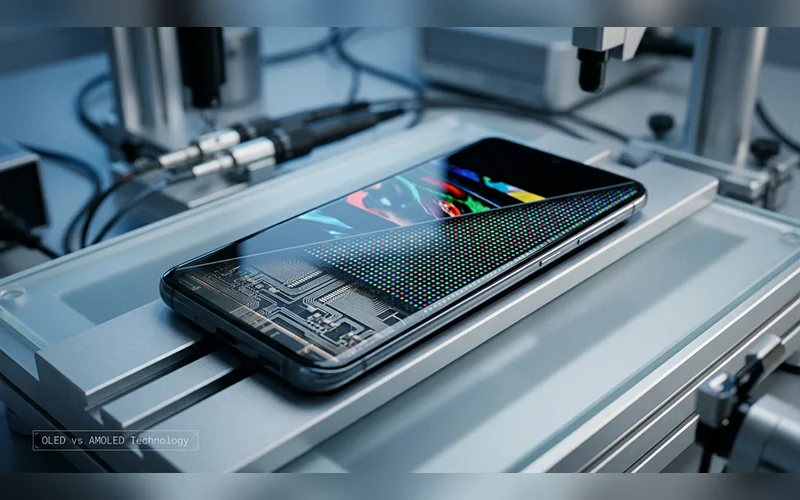
OLED vs AMOLED Technology Explained
The difference becomes clearer when you look at how the pixels are controlled inside the display.
How OLED Displays Work
An OLED pixel contains organic light-emitting material that produces light when an electrical current passes through it. Because each pixel generates its own light, it can be controlled independently and switched off completely when black is required.
This pixel-level control gives OLED displays their characteristic deep blacks, high contrast, fast response times, and wide viewing angles. OLED panels can also be manufactured in different forms and with different pixel-driving architectures, so the term “OLED” alone does not describe every detail of a panel’s construction.
How AMOLED Displays Work
AMOLED uses a TFT active-matrix backplane to control the current delivered to individual OLED pixels. Each pixel is connected to transistor circuitry that helps regulate its brightness and maintain its required state.
Active-matrix control is particularly useful for displays with millions of pixels because it allows them to be addressed quickly and precisely. This makes the architecture well suited to compact, high-resolution screens and displays with high refresh rates.
The practical oled vs amoled technology distinction is therefore mainly related to the way the pixels are driven. Both use OLED pixels to produce light, but AMOLED specifically identifies an OLED display with active-matrix control.
OLED vs AMOLED Picture Quality
When it comes to picture quality, neither OLED nor AMOLED automatically wins. Since AMOLED is an OLED implementation, both can deliver deep blacks, high contrast, wide viewing angles, and fast response times. The actual viewing experience depends more on the specific panel, calibration, brightness, and display settings.
Black Levels and Contrast
OLED-based displays have an advantage over LCD technology because individual pixels can be turned off completely. This allows them to produce extremely deep blacks and very high contrast, particularly in dark scenes.
Because AMOLED also uses self-emissive OLED pixels, it offers the same fundamental advantage. What you ultimately see depends on how the display panel is built and how effectively its pixels are managed.
Color Reproduction
Both OLED and AMOLED panels can support wide color gamuts and strong color reproduction. However, color accuracy depends on the panel’s calibration and factory tuning.
Some displays are designed for more saturated colors, while others prioritize accurate and natural reproduction. Therefore, the OLED or AMOLED label alone does not tell you how accurate the colors will look.
Brightness
Brightness can vary significantly between individual displays. Some AMOLED smartphone panels can achieve very high peak brightness for HDR highlights and outdoor viewing, while premium OLED monitors and TVs can also deliver strong brightness.
Peak brightness is only one part of the picture. Sustained brightness, thermal management, panel size, and the amount of the screen being illuminated can all affect real-world performance.
Viewing Angles
OLED displays generally provide excellent viewing angles because they do not rely on liquid crystals to control light from a separate backlight.
AMOLED retains this characteristic because it uses OLED pixels. Colors and contrast therefore tend to remain consistent when the screen is viewed from different angles.
Response Time
OLED technology can provide extremely fast pixel response because its pixels do not need to physically change the orientation of liquid crystals.
This makes OLED and AMOLED displays well suited to fast-moving content, including gaming, sports, and other scenes where motion clarity is important.
OLED vs AMOLED for Gaming
Gaming places several demands on a display, including fast response times, high refresh rates, low input latency, good motion handling, strong contrast, and consistent image quality. Both OLED and AMOLED can perform very well in these areas, but the better choice depends on the device and its specific specifications.
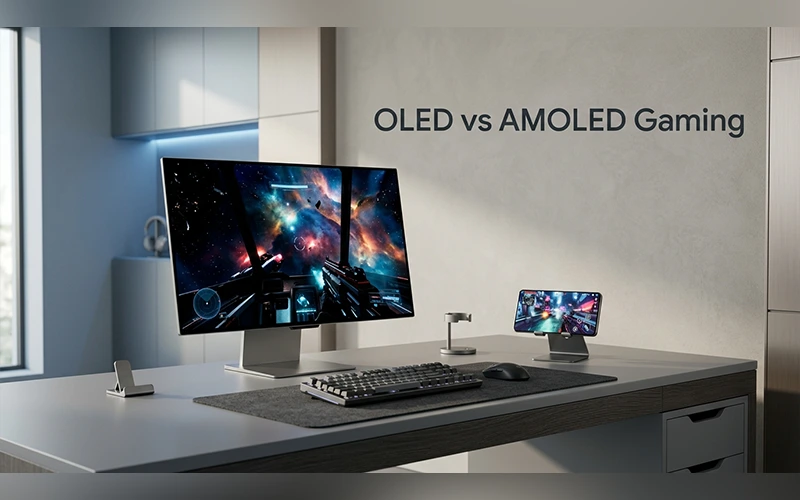
For desktop gaming, OLED monitors can offer high refresh rates, extremely fast pixel response, deep blacks, and strong contrast. These characteristics can make fast-moving scenes look clearer and dark scenes more detailed.
AMOLED is more common in smartphones and other portable devices. Its active-matrix architecture is well suited to compact, high-resolution displays and can support high refresh rates and adaptive refresh-rate systems. A compatible smartphone can adjust its refresh rate according to the content being displayed, helping balance smoothness and power consumption.
Therefore, there is no universal winner between OLED and AMOLED for gaming. An OLED gaming monitor may be the better choice for a desktop setup, while a high-quality AMOLED smartphone can provide an excellent gaming experience on a portable device.
Before choosing a gaming display, compare its actual refresh rate, response-time performance, input latency, variable-refresh-rate support, HDR capability, and brightness. These specifications can have a greater effect on gaming performance than the OLED or AMOLED label alone.
One Gaming Concern: Burn-In
OLED and AMOLED displays use organic light-emitting materials, so both can be susceptible to permanent image retention, commonly known as burn-in. The risk is higher when the same bright static elements remain on the screen for long periods.
Gaming interfaces can contain fixed elements such as health bars, maps, scoreboards, or other overlays. Extended exposure to these elements can contribute to uneven pixel wear over time.
Modern displays may include features such as pixel shifting, logo dimming, screen savers, and compensation cycles to reduce the risk. These features can help manage uneven wear, but they cannot eliminate the underlying possibility of burn-in.
OLED vs AMOLED: Which Is Better for Eyes?
Neither OLED nor AMOLED is universally better for eye comfort. The experience depends on factors such as brightness, viewing conditions, screen size, content, and the way a particular display controls its brightness.
One factor worth checking is PWM, or pulse-width modulation. Some OLED-based displays use rapid changes in pixel brightness to control screen brightness. Most people do not consciously notice this modulation, but some individuals may be more sensitive to it and experience discomfort or eye strain with certain displays.
This means that when comparing OLED vs AMOLED which is better for eyes, the panel type alone is not enough to determine which screen will be more comfortable.
Other factors can also affect viewing comfort:
- Set the screen brightness according to the surrounding environment.
- Avoid using an unnecessarily bright display in a dark room.
- Make sure text and interface elements are large enough to read comfortably.
- If you are sensitive to flicker, check the display’s PWM behavior and available dimming options.
- Use warmer display settings at night if they feel more comfortable.
- Take regular breaks during extended screen use.
Blue-light reduction is another setting some users may find comfortable, particularly at night, but OLED does not automatically make a display harmless to the eyes, and AMOLED is not inherently harmful. Eye comfort depends on the complete display system and how it is used.
OLED vs AMOLED vs Super AMOLED
Super AMOLED is a Samsung display branding term built around AMOLED technology. It should not be treated as a completely separate display technology alongside OLED and AMOLED.
The traditional Super AMOLED design integrates the touch-sensing function into the display structure instead of using a separate touch layer above the display. This can reduce the number of layers in the panel and help minimize reflections between them.
However, the exact construction and features can vary between generations and devices, so the Super AMOLED name alone does not guarantee a specific level of brightness, color accuracy, refresh rate, or overall image quality.
| Feature | OLED | AMOLED | Super AMOLED |
| Basic technology | Self-emissive OLED | Active-matrix OLED | Samsung-branded AMOLED implementation |
| Individual pixel lighting | Yes | Yes | Yes |
| Active-matrix control | Common in modern OLED displays | Yes | Yes |
| Touch integration | Depends on design | Depends on design | Integrated into the display structure in traditional Super AMOLED designs |
| Black levels | Excellent | Excellent | Excellent |
| Typical applications | TVs, monitors, phones, and other devices | Smartphones, tablets, and portable devices | Selected Samsung devices |
The simplest way to remember the relationship is: OLED is the broader display technology, AMOLED is an active-matrix implementation of OLED, and Super AMOLED is Samsung’s branding for a particular Amoled display design.
OLED vs AMOLED vs IPS
IPS belongs to a different display family. IPS, or In-Plane Switching, is a type of LCD technology that uses a backlight to illuminate liquid-crystal pixels. OLED-based displays work differently because their individual pixels produce their own light.
This difference affects several aspects of the viewing experience, including black levels, contrast, power consumption, response time, and the risk of permanent image retention.
| Feature | OLED / AMOLED | IPS LCD |
| Light source | Individual pixels | Backlight |
| Black level | Extremely deep | Usually lighter than OLED black |
| Contrast | Extremely high | Generally lower |
| Pixel response | Very fast | Varies by panel |
| Viewing angles | Generally excellent | Generally good to excellent |
| OLED-style permanent burn-in | Possible | No |
| Static-content use | Requires some consideration | Well suited |
| Dark-content efficiency | Can benefit from dark content | Backlight remains active |
| Typical price | Often higher | Available across a wide range |
The main advantage of OLED and AMOLED over IPS is their ability to switch individual pixels off. This allows dark areas of an image to remain extremely dark instead of receiving light from a backlight.
IPS has an important advantage for long periods of static use because it does not have the same organic-pixel burn-in mechanism associated with OLED displays. This can make it a practical choice for office work, spreadsheets, web browsing, and other workloads where the same interface elements remain on screen for many hours.
However, IPS should not be dismissed as a lower-quality option. A good IPS display can provide excellent color accuracy, strong brightness, and good viewing angles. For some users, those qualities combined with lower cost and the absence of OLED-style permanent burn-in can make IPS the better overall choice.
Which Is More Expensive: OLED or AMOLED?
There is no universal rule that AMOLED displays cost more than OLED displays. Because AMOLED is an active-matrix form of OLED, the technology label alone cannot determine the price of a screen.
The final cost depends on factors such as:
- Screen size
- Resolution
- Refresh rate
- Manufacturing yield
- Substrate material
- Brightness capability
- HDR performance
- Touch integration
- Flexible or foldable construction
- Production scale
- Brand and product positioning
A small AMOLED smartphone display, for example, can cost less to manufacture than a large premium OLED television panel because the two panels have very different size, construction, and manufacturing requirements.
So, if you are asking OLED vs AMOLED which is expensive, there is no fixed answer. In smartphones, AMOLED is often associated with more expensive devices because manufacturers commonly combine it with high refresh rates, high brightness, premium materials, and other advanced features. However, those features—not the AMOLED name itself—are what contribute to the higher price.
OLED vs AMOLED Differences in Everyday Use
The practical difference between OLED and AMOLED becomes clearer when you consider the type of device being used. Manufacturers do not always use the same terminology across product categories, even when the underlying display architecture is closely related.
Smartphones
AMOLED is widely used in smartphones because active-matrix control is well suited to compact, high-resolution displays. Modern phone panels can combine it with high refresh rates, HDR support, adaptive refresh rates, and other features that affect the overall viewing experience.
For a smartphone, it is therefore more useful to compare the actual panel specifications than to choose a phone based solely on the AMOLED label.
Televisions
Large premium televisions are generally marketed as OLED rather than AMOLED. These displays use sophisticated active-matrix driving systems, but manufacturers typically emphasize the OLED product category in consumer-facing specifications.
This is why the terms used in television and smartphone marketing should not be interpreted as evidence that the two products use completely different underlying display technologies.
Laptops and Monitors
OLED displays are increasingly common in laptops, monitors, and gaming displays. They can provide excellent contrast, fast response times, and strong image quality.
For these devices, buyers should also consider brightness, refresh rate, HDR performance, resolution, connectivity, and the amount of static content they expect to display.
Smartwatches and Wearables
AMOLED is popular in smartwatches and other wearables because it can provide strong contrast, bright colors, thin panel designs, and efficient operation when interfaces contain large dark areas.
The display’s size, brightness, refresh rate, and power-management system still determine how it performs in everyday use.
Flexible and Foldable Devices
OLED technology can be manufactured on flexible substrates, making it suitable for curved, flexible, and foldable displays. This capability has made OLED-based panels particularly important in foldable smartphones and other devices with unconventional screen designs.
Overall, the oled vs amoled differences are more useful for understanding how a display is built than for predicting which device will provide the better experience. The panel’s specifications and implementation matter more than the marketing term alone.
Which Display Should You Choose?
The right display depends on the device you are buying and how you plan to use it. Since AMOLED is an active-matrix form of OLED, the more useful comparison is between the specific panels available in each product rather than the technology name alone.
Choose an OLED Display If You Want
- Deep blacks and very high contrast
- Fast pixel response for gaming and movies
- Excellent viewing angles
- A premium TV, monitor, or laptop display
- Strong HDR performance when the panel has sufficient brightness
For large-screen TVs and desktop monitors, OLED is a common choice because its self-emissive pixels can deliver excellent contrast and fast response without a conventional backlight.
Choose an AMOLED Display If You Want
- A high-quality smartphone or portable display
- High pixel density
- High refresh rates
- Strong contrast and deep blacks
- A thin display suitable for compact devices
- Efficient operation when displaying darker content
AMOLED is particularly common in smartphones, tablets, smartwatches, and other portable electronics because its active-matrix architecture works well with dense, high-resolution screens.
Choose IPS If You Prefer
- A wider range of affordable display options
- Long periods of static productivity work
- No OLED-style burn-in concern
- A broad selection of screen sizes and brightness levels
- Good color accuracy without prioritizing perfect blacks
IPS can be a practical choice for office work, spreadsheets, web browsing, and general computing, especially when the same interface remains visible for many hours.
Ultimately, do not choose a display based only on whether it is labeled OLED, AMOLED, or IPS. Compare the actual brightness, refresh rate, response time, color accuracy, HDR performance, dimming behavior, and intended use before making a decision.
OLED vs AMOLED: Quick Comparison
| Category | OLED | AMOLED |
| Relationship | Broad self-emissive display technology | Active-matrix implementation of OLED |
| Pixel lighting | Individual pixels produce their own light | Individual pixels produce their own light |
| Black levels | Excellent | Excellent |
| Contrast | Extremely high | Extremely high |
| Response time | Very fast | Very fast |
| High refresh rates | Supported | Well suited |
| Burn-in risk | Possible | Possible |
| Eye comfort | Depends on the panel and brightness-control method | Depends on the panel and brightness-control method |
| Common applications | TVs, monitors, laptops, phones, and other devices | Smartphones, tablets, wearables, and other portable devices |
| Best choice | Depends on the specific product | Depends on the specific product |
The key point is that OLED and AMOLED are not competing technologies in the same way as OLED and IPS. AMOLED is a specific active-matrix implementation of OLED. For buyers, the individual panel’s brightness, refresh rate, color accuracy, HDR performance, dimming behavior, and other specifications are more useful than the label alone.
Conclusion
Although OLED and AMOLED are often treated as separate display types, they are built around the same core principle. OLED describes the underlying light-emitting display technology, whereas AMOLED identifies an OLED panel that is driven through an active-matrix arrangement.
That means there is no universal winner in the OLED vs AMOLED comparison. AMOLED is particularly well suited to smartphones, tablets, and other compact devices, while OLED is the more common consumer-facing term for televisions, monitors, and other larger displays.
For most buyers, the technology label should be only the starting point. Compare the actual panel’s brightness, refresh rate, response time, color accuracy, HDR performance, dimming method, power efficiency, and burn-in protections. These specifications provide a much better indication of how a display will perform in real-world use.
If you are choosing between two specific devices, compare their complete display specifications rather than assuming that OLED or AMOLED is automatically better.
Frequently Asked Questions
Is AMOLED better than OLED?
Not necessarily. AMOLED is an active-matrix form of OLED, so it is not a separate technology that automatically provides better picture quality. The quality of the individual panel, including its brightness, color accuracy, refresh rate, and calibration, matters more.
Is AMOLED just a type of OLED?
Yes. AMOLED is short for Active-Matrix Organic Light-Emitting Diode. It uses organic light-emitting pixels together with an active-matrix layer that manages each pixel through its own transistor control.
Which Display Is Better for Gaming: OLED or AMOLED?
Both can provide excellent gaming performance. The better option depends on the device and its specifications, particularly refresh rate, response time, input latency, brightness, HDR performance, and variable-refresh-rate support.
Is OLED better for eyes than AMOLED?
Neither is automatically better for eye comfort. Brightness, viewing conditions, and the display’s dimming method can have a greater effect. Users who are sensitive to flicker should also consider the panel’s PWM behavior.
Is Super AMOLED better than AMOLED?
Super AMOLED is Samsung’s branding for a particular AMOLED display design rather than a completely separate display technology. Its advantages can include integrated touch sensing and fewer display layers, but the actual viewing experience depends on the specific device and panel.
Is IPS better than OLED?
IPS can be the better choice for users who prioritize affordability, long periods of static productivity work, or avoiding OLED-style burn-in. OLED generally has an advantage in black levels, contrast, and pixel response.
Which display is best for phones?
AMOLED is well suited to smartphones because active-matrix OLED technology supports compact, high-resolution displays with strong contrast and high refresh rates. However, the best phone display still depends on the specific panel’s brightness, color accuracy, refresh rate, power efficiency, and dimming behavior.
For more articles like this, visit our site: https://factbreaker.com/