



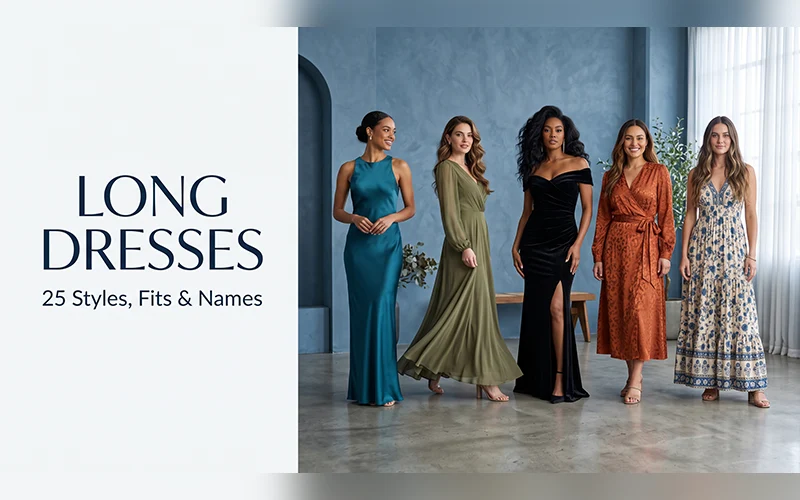
Long dresses range from loose everyday silhouettes to highly structured gowns designed for major occasions. Although many extend to the ankle or floor, their shapes can be completely different. The bodice, waistline, skirt volume, neckline, sleeves, and closure all affect how a dress looks and moves.
Learning the types of long dresses makes it easier to shop with a specific silhouette in mind instead of choosing only by color or fabric. It also helps when reading product descriptions, because terms such as A-line, empire waist, mermaid, or column describe particular construction details.
This guide covers 25 distinct designs, followed by practical ways to select and style them.
25 Types of Long Dresses and Their Names
1. Maxi Dress
The maxi is mainly defined by its extended length. It may be loose, straight, fitted, gathered, or layered.
2. A-Line Dress
When comparing types of long dresses, the A-line is easy to identify by its gradual flare. The flare begins smoothly instead of creating a sudden burst of volume.
3. Ball Gown
The ball gown is one of the most formal silhouettes because of its unusually full skirt. Layers of tulle, netting, crinoline, or gathered fabric can create the dramatic volume associated with this silhouette.
4. Mermaid Dress
The mermaid is a striking member of the types of long dresses because its flare appears low on the body. The contrast between the narrow upper portion and wider lower section produces its signature shape.
5. Trumpet Gown
The trumpet silhouette begins widening earlier than the mermaid shape, which begins widening earlier. This creates a more gradual change from the fitted upper body to the wider skirt.
6. Sheath Dress
For a narrow profile, types of long dresses include the sheath, whose skirt stays controlled. It follows the body’s general shape from the upper section toward the hem and usually avoids a dramatic flare.
7. Column Dress
The column creates a straight outline without requiring a close fit. The material can skim the body, creating a more relaxed interpretation of the narrow silhouette.
8. Empire Waist Dress
A raised waist creates one of the most recognizable types of long dresses, the empire silhouette. This creates an uninterrupted length through the lower portion of the garment.
9. Wrap Long Dress
The wrap belongs to types of long dresses identified by their crossing front rather than by a particular skirt shape. The overlap often creates a V-shaped neckline.
10. Slip Dress
Among modern types of long dresses, the slip is notable for its lightweight construction. Long versions generally use thin shoulder straps and fabrics such as satin or silk.
11. Tiered Dress
Tiering creates movement by dividing the skirt into horizontal sections. The pieces are often gathered, so each added tier creates more width and movement.
12. Ruffle Dress
The ruffle version gets its character from gathered decorative fabric. Ruffles can frame a neckline, finish sleeves, cross the bodice, or follow the skirt.
13. Pleated Dress
Pleating gives the dress its texture through repeated folds rather than added ornament. Fine pleats can add movement to lightweight fabric, while broad folds can give heavier material a structured, sculptural quality.
14. Kaftan Dress
The kaftan is recognized for its generous, flowing shape. Wide sleeves, embroidery, borders, side openings, and bold prints may be added without changing its relaxed foundation.
15. Shirt Dress
The shirt dress stands out through its button-up details. It may include a collar, front buttons, cuffs, a placket, or a chest pocket.
16. Corset Dress
Structured types of long dresses can use a corset bodice to create a defined upper section. The skirt is not fixed to one shape.
17. One-Shoulder Dress
The one-shoulder design uses an asymmetrical neckline that exposes one shoulder. The opposite side may have a strap, sleeve, or broader panel.
18. High-Low Dress
A high-low hem gives one category of types of long dresses its instantly uneven profile. These variations can range from barely noticeable to distinctly striking.
19. Princess Dress
Romantic types of long dresses often include the princess silhouette, with its shaped bodice and fuller skirt. Long seams can divide the garment vertically and help it maintain a structured appearance.
20. Bodycon Long Dress
Close-fitting types of long dresses include the bodycon design, which relies on a narrow outline. It relies on stretch construction to maintain close contact while still allowing ordinary movement.
21. Boho Maxi Dress
Bohemian types of long dresses often combine a relaxed maxi shape with expressive prints and decorative details. Floral or paisley prints, embroidery, tassels, relaxed sleeves, and flowing fabrics are typical examples.
22. Long-Sleeve Maxi Dress
A long-sleeve maxi combines a full-length skirt with sleeves that reach the wrists. The body can be straight, flowing, gathered, or fitted.
23. Strapless Dress
A strapless long dress leaves the shoulders uncovered and uses a fitted upper edge to hold the garment in place. The neckline can be straight, softly curved, or sweetheart-shaped.
24. Cape Dress
A cape dress adds a cape-like layer around the shoulders or upper body. The overlay may fall behind the arms, reach toward the floor, or be integrated directly into the dress.
25. Off-Shoulder Dress
An off-shoulder dress sits below the shoulders and leaves both shoulders exposed. The neckline can be smooth, gathered, elasticated, lace-trimmed, or finished with ruffles.
How to Choose the Right Long Dress
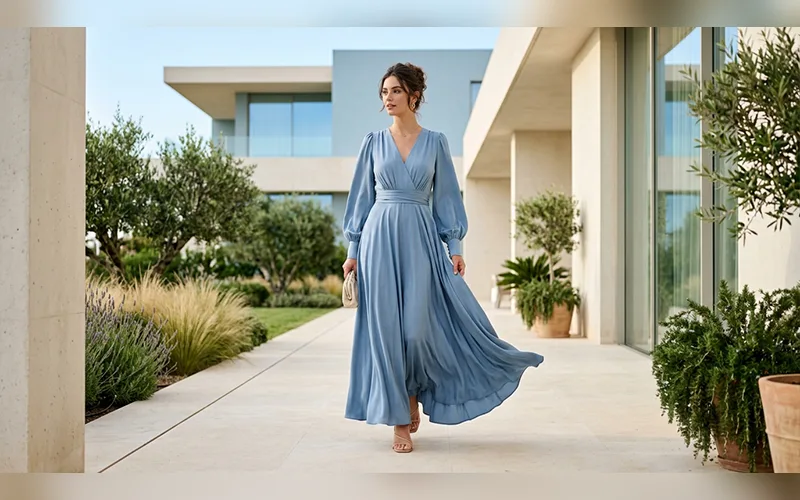
Choosing among the types of long dresses becomes simpler when the decision begins with the setting. A daytime lunch, destination holiday, formal reception, and gala do not require the same level of structure.
After the occasion, consider the fabric. Cotton and breathable rayon are practical for heat, chiffon offers movement, satin creates a smoother evening surface, and firmer textiles help maintain structured shapes.
Next, check the construction. A fitted skirt behaves differently from a flowing one, and a raised waist changes where the fabric begins to fall. Neckline and sleeve choices can then be considered separately.
Length also deserves a practical check. The hem should work with the intended shoes and the amount of walking involved. If dancing, stairs, or outdoor movement is expected, the easiest-looking garment on a hanger may not be the easiest to wear.
Before ordering online, check garment measurements rather than relying only on the listed dress size. Bust, waist, hip, shoulder, and length can vary between brands. Look at the lining and fastening as well: a concealed zipper creates a different fit requirement from an elastic waist, and a lined skirt may hang differently from an unlined one. Care instructions are worth checking when choosing satin, pleated material, embellished fabric, or delicate lace. These details help prevent a style that looks right from becoming impractical after purchase.
Long Dresses for Different Occasions
Among the types of long dresses, event context can matter as much as personal preference. The right choice from the types of long dresses for women depends on venue, dress code, season, and personal preference.
Long Dresses for Weddings
Wedding outfits can range from understated daytime dresses to elaborate evening gowns. A-line, princess, empire waist, mermaid, trumpet, and column silhouettes can all be adapted by changing fabric and detailing.
The invitation remains the most useful guide. A garden ceremony, ballroom reception, and destination wedding may each call for a different level of formality.
Long Dresses for Parties
Partywear gives more freedom to use distinctive details. One-shoulder necklines, satin slips, bodycon shapes, ruffles, and high-low hems can create interest without relying on a huge skirt.
The venue should influence the final choice. A restaurant dinner, dance floor, rooftop gathering, and formal celebration can have very different practical requirements.
Long Dresses for Casual Days
Casual wardrobes benefit from lighter construction and easier movement. Relaxed maxis, shirt dresses, tiered styles, kaftans, and boho silhouettes can work for errands, lunches, travel, and ordinary daytime plans.
Breathable materials are often more useful here than intricate embellishment. Simple footwear can keep the outfit grounded and practical.
Long Dresses for Formal Events
Formal dressing gives structured and polished silhouettes more room to shine. Ball gowns bring volume, while columns, sheaths, mermaids, trumpets, and refined A-lines provide alternatives with less skirt fullness.
The dress code should be checked before shopping. A black-tie requirement is not interchangeable with a semi-formal invitation, so the expected level of dressiness matters.
Long Dresses for Summer
Summer choices usually benefit from breathable materials and relaxed construction. Light maxi styles, kaftans, tiered dresses, slip silhouettes, and off-shoulder designs can all work when made in suitable fabric.
The goal is not simply to find a dress that looks summery; it should also allow comfortable movement and avoid unnecessary weight.
Types of Long Dresses Names With Pictures
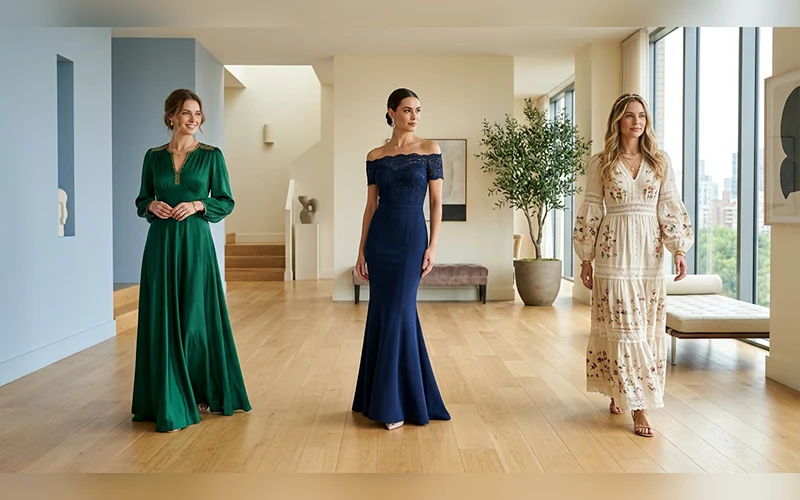
Readers looking for a visual naming guide generally want the visual difference between silhouettes to be obvious. Each style image should therefore show the full garment from neckline to hem instead of using a close crop.
The picture should match the heading exactly. A mermaid image should clearly show the knee-level flare, while an empire waist image should make the raised waistline visible. Good image selection turns the article into a practical reference rather than a text-only list.
Long Dress Names for Women
The search phrase Women types of long dresses names covers a broad subject because long dresses are defined by construction rather than by one age group or occasion.
A useful way to organize a wardrobe is to keep a mix of shapes: a relaxed design for ordinary days, a lightweight option for warm weather, a polished silhouette for formal invitations, and a more distinctive style for parties. This provides variety without relying on repeated versions of the same cut.
How Long Dress Categories Differ
The Different types of long dresses found in fashion collections can be separated by four useful features: silhouette, waist placement, closure, and neckline.
Silhouette includes shapes such as A-line, column, sheath, mermaid, and bodycon. Waist placement distinguishes natural-waist and empire constructions. Closure explains designs such as wrap dresses, while neckline terms identify one-shoulder, strapless, and off-shoulder versions.
This approach is more useful than treating every full-length garment as simply a “maxi,” because a maxi can use many different constructions.
Long Dress Styles for Ladies
When people search for Types of long dresses for ladies, they may be looking for names to use while shopping, comparing outfits, or choosing a style for an event.
The clearest method is to identify the main shape first and then look at fabric and details. Someone interested in a narrow profile can begin with sheath or column options, while a fuller skirt points toward princess or ball-gown constructions. Relaxed choices include kaftan, tiered, and flowing maxi designs.
Long Dress Styles at a Glance
For a quick reference, this table summarizes the main dress names by the feature that makes each one recognizable.
| Style | Defining Feature | Common Setting |
| Maxi | Ankle-to-floor length | Everyday, travel |
| A-Line | Gradual skirt flare | Weddings, parties |
| Ball Gown | Very full skirt | Galas, formal events |
| Mermaid | Flare around knees | Eveningwear |
| Trumpet | Flare from mid-thigh | Formalwear |
| Sheath | Narrow tailored line | Polished occasions |
| Column | Straight vertical fall | Eveningwear |
| Empire Waist | Waist below bust | Romantic, formal |
| Wrap | Cross-over front | Day to evening |
| Slip | Thin straps, fluid fabric | Modern eveningwear |
| Tiered | Joined horizontal sections | Casual, summer |
| Ruffle | Gathered decorative strips | Parties |
| Pleated | Repeated folds | Day or evening |
| Kaftan | Loose flowing body | Resort, warm weather |
| Shirt Dress | Shirt-inspired details | Casual, smart-casual |
| Corset | Structured bodice | Parties, evening |
| One-Shoulder | Asymmetrical neckline | Formal, evening |
| High-Low | Shorter front hem | Events, parties |
| Princess | Fuller structured skirt | Bridal, formal |
| Bodycon | Close-fitting cut | Parties, nightlife |
| Boho Maxi | Relaxed bohemian details | Vacation, outdoor |
| Long-Sleeve Maxi | Wrist-length sleeves | Cooler weather |
| Strapless | No shoulder straps | Formal, bridal |
| Cape Dress | Cape-like upper layer | Formal, evening |
| Off-Shoulder | Exposed shoulder line | Summer, celebrations |
Styling Long Dresses
Styling the types of long dresses is easier when the accessories support rather than compete with the strongest design feature.
A detailed cape, large ruffle, or asymmetrical neckline already creates visual interest, so restrained jewelry may keep the outfit balanced. A plain dress gives more room for a statement bag, earrings, necklace, or belt.
Footwear changes the result as well. Sandals keep relaxed silhouettes informal, heels add a dressier finish, and boots can give a long outfit a cooler-season direction. The hem and venue should be considered before choosing shoes.
Outer layers can also alter the proportions. A blazer adds structure, a cardigan creates softness, and a jacket can provide warmth while leaving the main silhouette visible.
Final Thoughts
The wide range of types of long dresses makes it possible to find a silhouette for almost any personal style, season, or occasion. From an uncomplicated maxi for everyday plans to a structured gown for a formal celebration, each design has its own construction and visual character.
Understanding the names behind these styles makes shopping and outfit planning easier. Instead of choosing only by color or decoration, you can identify the shape, waistline, neckline, and overall structure that match what you are looking for. With that knowledge, finding a long dress becomes a more straightforward and informed part of building a versatile wardrobe.
Frequently Asked Questions
How should a full-length hem sit?
The hem should work with the intended footwear and should not drag on the ground. Check the finished garment length rather than judging it from a model photograph.
Does fabric change how a long dress looks?
Yes. Soft materials tend to fall and move, while firmer textiles hold a clearer shape. Surface finish also matters: satin reflects light, while textured materials can make simple construction more noticeable.
How can I tell two similar silhouettes apart?
Look first at the waistline, where the skirt begins to widen, and how closely the fabric follows the body. These points reveal differences that may be difficult to notice from a small image.
Are long dresses suitable for everyday wear?
They can be. Consider fabric weight, movement, closure, and footwear. Relaxed construction usually works better for repeated daytime use than heavily structured occasionwear.
What should I check before buying one online?
Compare your body measurements with the retailer’s chart and check the garment length. Review the fastening, lining, fabric composition, and care instructions before ordering.
Can the same dress be styled appropriately for different occasions?
Yes. A simple design can change character through shoes, jewelry, outerwear, and a bag. The base fabric and silhouette still need to suit both settings.
Which details make a formal dress look more structured?
A fitted bodice, defined seams, supportive lining, shaped waist, and fabrics with enough body can create a more structured appearance. Boning or built-in support may add further definition in some designs.
What makes a dress feel more relaxed?
Looser construction, flowing material, simple closures, soft prints, and uncomplicated accessories generally create a less formal result. The absence of heavy internal structure can also make the garment easier to move in.
How do I choose accessories for a detailed dress?
Start with the dress’s most noticeable feature. When the neckline, sleeve, cape, or skirt already has strong decoration, simpler accessories usually keep the outfit visually balanced.
Can long dresses be layered?
Yes. Jackets, blazers, cardigans, shirts, and light outer layers can be added depending on the fabric and proportions. The layer should leave enough room for the dress to fall naturally rather than bunching it around the body.
For more articles like this, visit our site: https://factbreaker.com/