



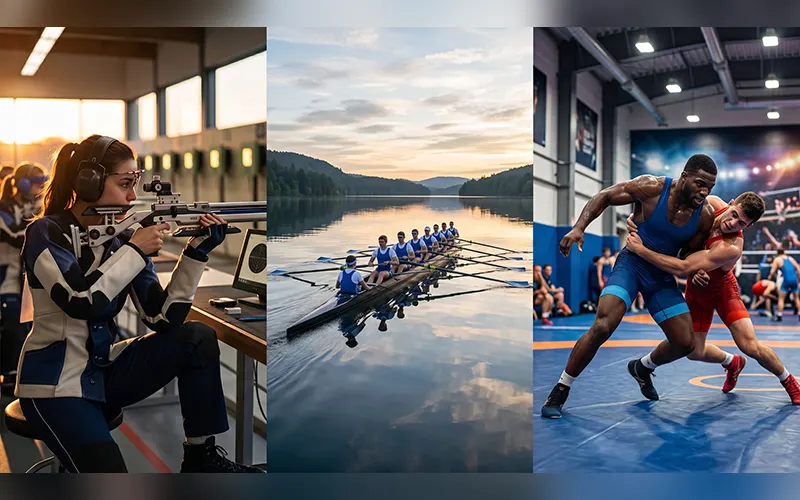
The easiest Olympic sports overall are shooting, archery, and curling — all three rely more on precision, balance, and mental composure than on cardiovascular fitness, which is why they attract competitors well into their 40s and 50s.
No sport at the Olympic level is genuinely easy — every athlete on that field or sheet of ice has put in years of work most people will never match. Still, some sports ask far less of the body than others, and a few even offer legitimate shortcuts to a spot on the roster.
So what are the easiest Olympic sports, really? The honest answer depends on what you’re measuring: physical demand, how fast you can learn the rules, or how realistic your actual path to qualification is. A sprinter and a curler are both Olympians, but the training, the age range, and the road that got them there look almost nothing alike.
Three Different Ways to Define “Easy”
Before ranking anything, it helps to separate the question into its actual parts, because “easiest” changes meaning depending on what’s being measured:
- Physical demand – Which sports forgive a slower, older, or less conditioned athlete because they don’t lean on cardiovascular fitness?
- Learning curve – Which sports can a total beginner understand and start playing within a day, without years of coaching first?
- Qualification system – How much of reaching the Olympics comes down to the size of the competitive field and quota rules, rather than raw talent alone?
Keeping these three lenses separate is the only way to give an honest answer instead of a vague one.
Sports That Ask the Least of Your Body
These sports prioritize fine motor skills and composure over endurance, which is why they have the widest age range of any competitors at the Games:
- Shooting – Comes down almost entirely to hand-eye coordination and the ability to stay still. It’s arguably the most age-accessible summer sport, since competitors have qualified and won medals well into their 40s and 50s — something you’d never see in sprinting or swimming.
- Archery – Leans more on core strength and a repeatable, consistent form than on raw athleticism, which is part of why it’s so accessible to people who take it up later in life.
- Curling – The lowest-impact sport at the Winter Games. A match can run for hours, but there’s no sprinting between ends; success comes down to strategy, balance, and how precisely you can slide a stone down the sheet.
The Easiest Olympic Sports to Qualify For
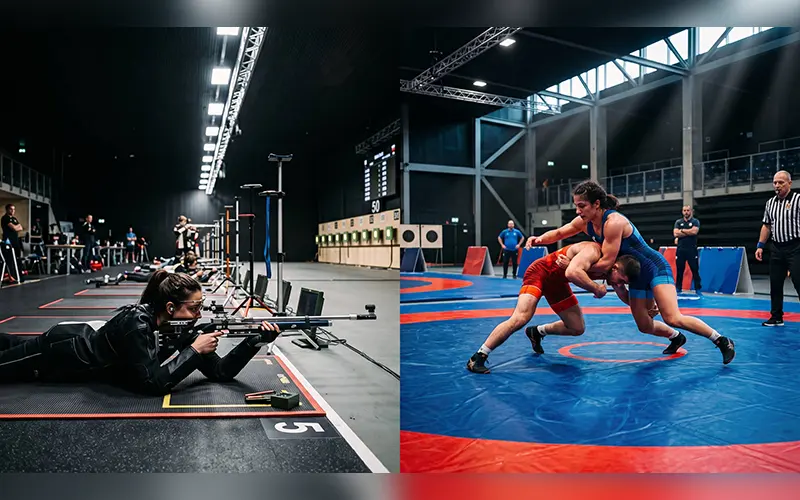
If you’re asking about the easiest Olympic sports to qualify for rather than the easiest to physically play, the answer has less to do with athletic skill and more to do with geography.
Many niche sports, especially at the Winter Games, award quota spots to underrepresented countries to keep the field internationally diverse.
An athlete who gains citizenship or residency in a small nation without a competitive team can bypass thousands of rivals in a powerhouse country and only needs to meet a bare minimum international standard.
Winter Sports
- Cross-Country Skiing – Venture capitalist Paul Bragiel reached the Olympics in this sport by moving to Colombia and mapping out which winter events had the most flexible qualification rules; downhill skiing, cross-country skiing, bobsled, and luge all made his shortlist.
- Luge – Draws from an especially small global talent pool, simply because so few countries have the icy chutes needed to train.
- Bobsled – National federations sometimes actively recruit converted sprinters or athletes from unrelated sports just to fill out a roster, since so few nations run competitive programs.
Summer Sports
The physical side of these sports is already covered above — what’s worth flagging here is the specific barrier standing between a beginner and an actual Olympic spot:
| Sport / Role | Primary Barrier to Qualifying |
| Rowing Coxswain | Strict weight limit around 55 kg (about 121 lbs) |
| Shooting | High cost of specialized firearms and ammunition |
| Archery | Extreme psychological pressure and constant equipment tuning |
| Modern Pentathlon | High financial investment and time commitment across five disciplines |
Modern Pentathlon is worth calling out specifically: despite requiring five separate disciplines, it draws from one of the smallest global talent pools in the entire Olympic program, which works in a determined newcomer’s favor.
What ties both lists together is scale: none of these events draw anywhere near the number of entrants that swimming, track, or football do, so the bar to simply make the field — rather than win a medal — sits considerably lower.
Top 10 Easiest Olympic Sports, Ranked
Combining physical demand, qualification pathways, and the size of the global competition pool, here’s a realistic ranking of the top 10 easiest Olympic sports:
| Rank | Sport | Why It’s Easier |
| 1 | Rowing Coxswain | No rowing required — just steering and tactics |
| 2 | Shooting | Built on stillness and precision, not peak fitness |
| 3 | Curling | Low-impact, strategy-first Winter sport |
| 4 | Luge | Extremely small global talent pool |
| 5 | Cross-Country Skiing | Flexible qualification rules for small-nation athletes |
| 6 | Bobsled | Open to strong sprinters switching sports late in their careers |
| 7 | Archery | Rewards composure and upper-body mechanics over speed |
| 8 | Golf | A skill-based game elite players can compete in for decades |
| 9 | Table Tennis | Simple rules that are easy to pick up fast |
| 10 | Equestrian Dressage | The horse carries the aerobic load, not the rider |
Golf might be the hardest sport on this list to actually master, but it involves no sprinting or high-impact collisions, which is why professionals routinely stay competitive into their 40s and 50s — some, like the majors circuit’s senior tours, well beyond that.
Equestrian dressage works on a similar principle — it takes serious core strength, balance, and a highly trained (and expensive) horse, but a skilled 60-year-old rider can genuinely beat a rider half their age, since the horse is doing most of the heavy aerobic work.
Easiest Olympic Sports for Beginners
Loopholes like small-nation quotas explain how someone might qualify, but they don’t answer a more practical question: what are the easiest Olympic sports to get into if you just want to start playing?
For that, cost and access matter far more than qualification rules — you’re not competing against a global field, just looking for the lowest barrier between you and your first session.
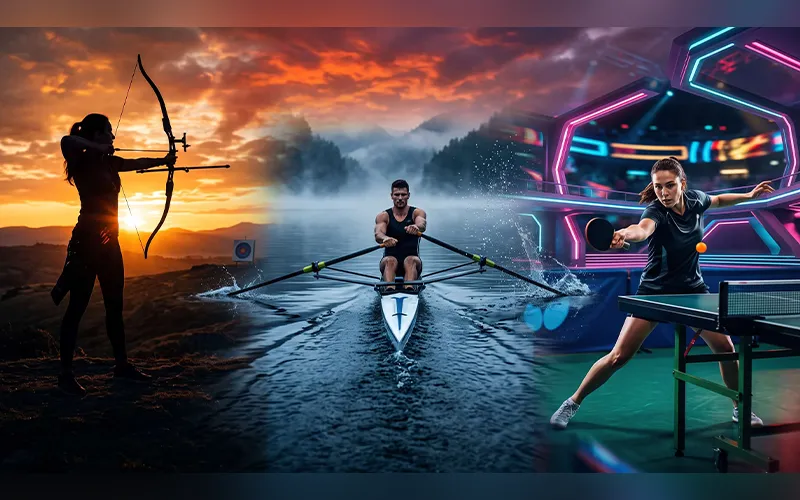
That rules out sports like luge or bobsled here; they may offer a qualification shortcut, but they’re nearly impossible for an average person to casually take up, since most places simply don’t have an ice track to train on.
- Table Tennis – A paddle and a set of balls cost less than $20, and tables are already sitting in community centers, bars, parks, and schools worldwide.
- Badminton – Rackets and shuttlecocks are cheap and widely available; the shuttlecock moves slower through the air than a tennis ball, giving beginners more time to react, and no formal court is required.
- Running – Needs nothing but a pair of shoes and a front door, since it’s one of the few Olympic disciplines built entirely on a movement the body already knows.
- 3×3 Basketball – Needs only half a court, one hoop, and a single ball, and public outdoor hoops are common enough worldwide that pick-up games are easy to find almost anywhere.
- Breaking – Requires no equipment beyond a flat, solid surface; most beginners learn through free tutorials online or by joining local dance studios and community practice jams.
- Archery – Most mid-sized cities have indoor ranges where beginners can rent a bow by the hour, and since the sport doesn’t demand peak cardiovascular fitness, people of nearly any age can start without months of conditioning first.
Easiest Olympic Sports to Learn
Getting into a sport and learning it are two different challenges. Some of the easiest Olympic sports to learn have rulebooks you can fully grasp in a few minutes:
- Running – Start behind the line, stay in your lane, cross the finish first. No judging panel or scoring system to memorize.
- Table Tennis – First side to 11 points wins, and serves rotate every two points, so tracking the score never gets complicated.
- 3×3 Basketball – Shots are worth 1 point inside the arc and 2 points outside it, played on half a court with a single 12-second shot clock; the match ends automatically once a team hits 21 points.
- Weightlifting – Only two lifts to learn — the snatch and the clean and jerk. Get the bar overhead and hold it steady until the judges signal, and you’ve succeeded.
- Archery – Competitors shoot at a large, color-coded target 70 meters away, with point values stepping up from 1 on the outer ring to 10 in the dead center. The core mechanics — nocking, drawing, aiming, releasing — can be taught to a total beginner in a single afternoon.
- Fencing (Épée) – Saber and foil both use a confusing “right-of-way” rule to decide who scores when both fencers land a hit at once. Épée skips that entirely: whoever touches first gets the point, and simultaneous hits award both fencers a point.
The Bottom Line
There’s no single answer to which Olympic sport is easiest, because “easy” means something different depending on whether you’re chasing a medal, a qualification slot, or just a new hobby.
Shooting, archery, and curling remain the top picks for anyone starting later in life and wanting the lowest physical toll.
If qualification is the real goal, geography and underrepresented-nation quotas open doors that pure athletic talent can’t.
And if you just want to pick up a paddle, a bow, or a pair of running shoes this weekend, table tennis, archery, and running are about as low-barrier as the Olympic program gets.
Whichever angle brought you here, the common thread is the same: the version of “easy” that matters is the one that fits what you’re actually trying to do.
Frequently Asked Questions
What are the easiest Olympic sports overall?
Shooting, archery, and curling are generally considered the easiest overall. None of them demand the cardiovascular endurance that running, swimming, or team sports do.
What are the top 10 easiest Olympic sports?
Rowing coxswain, shooting, curling, luge, cross-country skiing, bobsled, archery, golf, table tennis, and equestrian dressage top the list. The ranking blends physical demand, qualification field size, and how fast a beginner can learn them.
What are the easiest Olympic sports to qualify for?
Cross-country skiing, luge, bobsled, shooting, and archery are the easiest to qualify for. This is mostly thanks to small-nation quota rules, not lower skill requirements.
What are the easiest Olympic sports to get into as a beginner?
Table tennis, badminton, running, 3×3 basketball, and breaking are the easiest to casually pick up. They need little to no equipment and are available almost everywhere.
What are the easiest Olympic sports to learn?
Running, table tennis, 3×3 basketball, weightlifting, archery, and épée fencing have the simplest rulebooks. Most can be understood within just a few minutes.
Why are the easiest Olympic sports suitable for older athletes in shooting and archery?
Both sports depend on stillness and precise technique rather than cardiovascular fitness or explosive power. That’s why competitors in their 40s and 50s regularly make Olympic teams in these events.
Is it really possible to qualify for the Olympics through a small country in the easiest Olympic sports?
Yes — venture capitalist Paul Bragiel famously did this in cross-country skiing through Colombia. Small nations without a competitive program still get quota spots, lowering the qualifying bar considerably.
What is the easiest Winter Olympic sport among the easiest Olympic sports?
Curling is usually considered the easiest, since it’s the Games’ lowest-impact event and leans on strategy over speed. Luge, bobsled, and cross-country skiing are easier to qualify for, but still demand real conditioning.